
No products in the cart.
Trade Show Booth Sizes Explained: 10×10 vs 10×20 vs 20×20
Choosing between trade show booth sizes starts with what your exhibit must do. The smallest workable footprint is the one that supports the required activities, visitors and equipment without relying on the public aisle for extra space.
A standard booth size is a booking description, not a complete design brief. Two spaces with the same area can differ in frontage, open sides, access and display restrictions. Confirm the assignment before deciding which display system to buy.
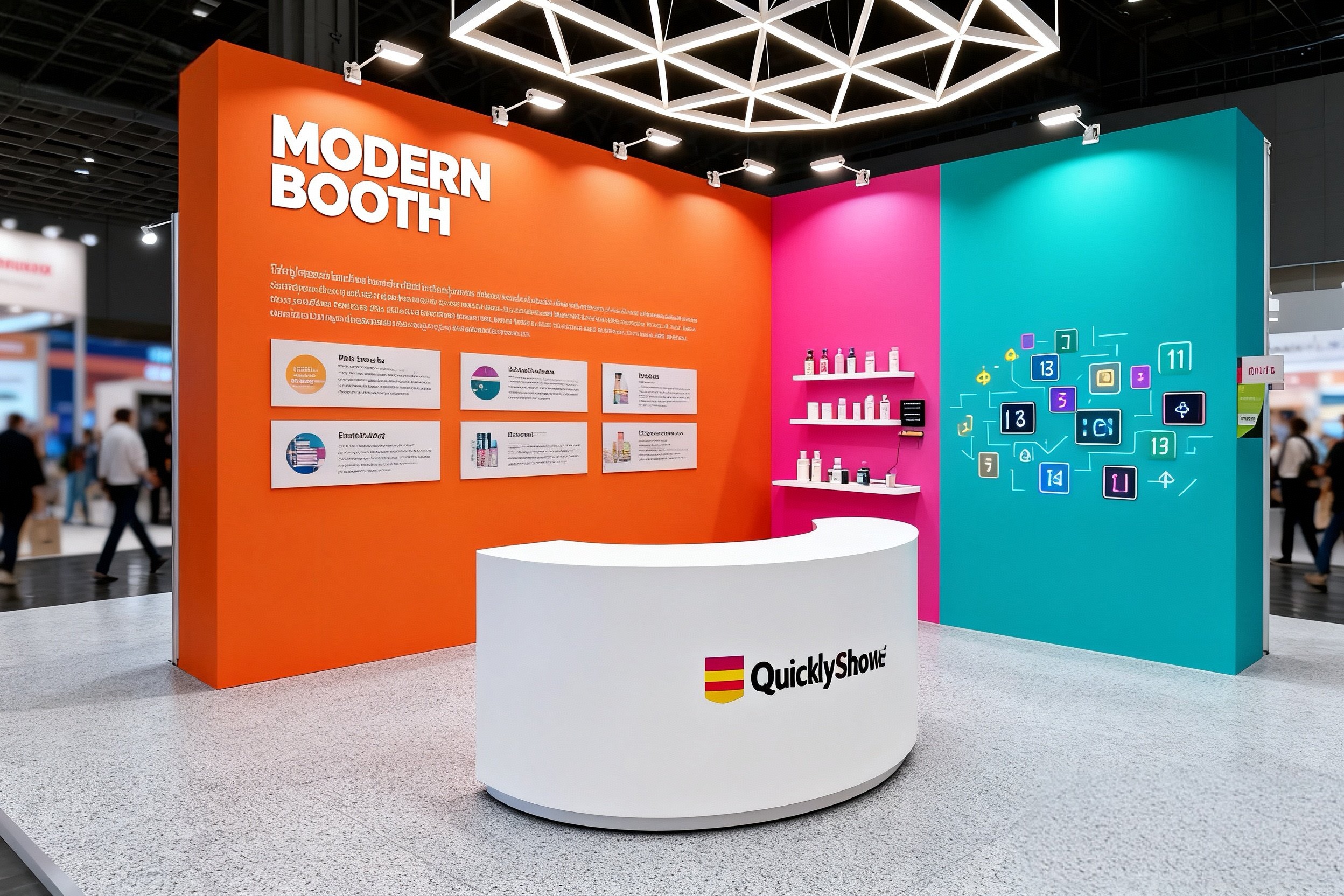
Compare the dimensions first
| Footprint | Area | Approximate metric dimensions | Approximate metric area |
|---|---|---|---|
| 10×10 ft | 100 sq ft | 3.05 x 3.05 m | 9.29 sq m |
| 10×20 ft | 200 sq ft | 3.05 x 6.10 m | 18.58 sq m |
| 20×20 ft | 400 sq ft | 6.10 x 6.10 m | 37.16 sq m |
The figures above are conversions of the stated imperial sizes. A three-by-three-meter space is slightly smaller than a 10×10-foot space. Check actual ordered dimensions and assembly tolerances before assuming a display will fit both.
Choose 10×10 for one main interaction
A 10×10 trade show booth is a useful starting point when the exhibit revolves around a focused demonstration, selected products or a small discussion area. The planning advantage is clarity: every item needs to earn its place.
Write down the interaction you need and build a full-size mock-up around it. If the plan works only while chairs are pushed in, storage is closed and no visitors are present, it needs revision.
A smaller footprint also requires disciplined stock planning. Decide what must be physically available and what can be shown through a catalog or screen. Do not remove necessary materials simply to make a rendering look spacious.
Choose 10×20 for related activities that need separation
A 10×20 exhibition booth can support a demonstration alongside follow-up discussion, or two product groups with a shared review area. Its value comes from reducing conflict between those activities.
Check orientation carefully. When the 20-foot side faces the aisle, visitors can approach different zones along the frontage. When the ten-foot side faces the aisle, the deeper arrangement needs a different entry and movement plan.
Before upgrading, identify the specific problem the extra space solves. Examples include a demonstration audience blocking appointments or a product comparison requiring a second work surface. “More impressive” is too vague to guide a floor plan.
Choose 20×20 when the operating plan needs the area
A 20×20 modular booth offers four times the area of a 10×10. That can support more substantial equipment, several product stations or activities that need meaningful separation. It also requires a clearer operating plan.
Assign responsibilities for greeting, demonstrations, appointments and replenishment. A large footprint with no one managing arrivals may feel confusing even when the display is attractive.
Do not infer island status from the dimensions. Verify the aisle exposure and booth classification with the organizer; the placement changes how the exhibit should work. [1]
Compare the full event budget
Evaluate space rental, display hardware, graphics, freight, material handling, installation, power, furniture, storage and staffing. Request comparable quotes using the same assumptions and inclusions.
Costs do not necessarily rise in direct proportion to area. Some items are fixed, while others depend on weight, labor requirements or venue services. A larger booking can also require additional staff travel even when the booth hardware changes very little.
For repeated events, compare a portable booth kit across the actual calendar. List which components can be reused, which graphics need replacement and what must be purchased for each configuration. Reconfiguration is valuable only when the parts, packing and assembly process support it.
Make the decision with a practical test
List the essential activities and equipment. Draw the smallest plausible arrangement, including occupied furniture and storage access. Test it with people. Move to the next size when you can name the conflict that the additional area resolves.
Repeat the exercise for the busiest expected moment, not just a quiet conversation. This gives you a reasoned choice and a useful brief for your supplier.
Frequently asked questions
Is 10×10 the right standard booth size for every first-time exhibitor? No. Equipment and visitor activities matter more than whether it is your first event.
Is 20×20 twice as large as 10×10? Each side is twice as long, but the area is four times as large: 400 versus 100 square feet.
Can one display cover all three sizes? Some systems support multiple configurations. Request a verified parts and graphics plan for each footprint before purchasing.
Send QuicklyShow your event calendar, booked dimensions and essential activities to discuss a display plan across different booth sizes.
[1] IAEE Guidelines for Display Rules and Regulations, 2019 North American Update. Consult the event organizer for the rules that apply to your assigned space.
