
No products in the cart.
Corner Booth vs Inline Booth: Which Layout Works Best?
A corner trade show booth and an inline booth can occupy the same footprint while needing different layouts. The key distinction is aisle exposure: an inline position normally opens to one aisle, while a corner position opens to two adjacent aisles. IAEE's 2019 North American guidance treats a corner as a linear booth at the end of a row. [1]
Choose between them by considering visitor approaches, display needs and how your team will operate. A second open side gives you another way to engage people, but it also changes where graphics, equipment and staff should go.
How an inline booth organizes attention
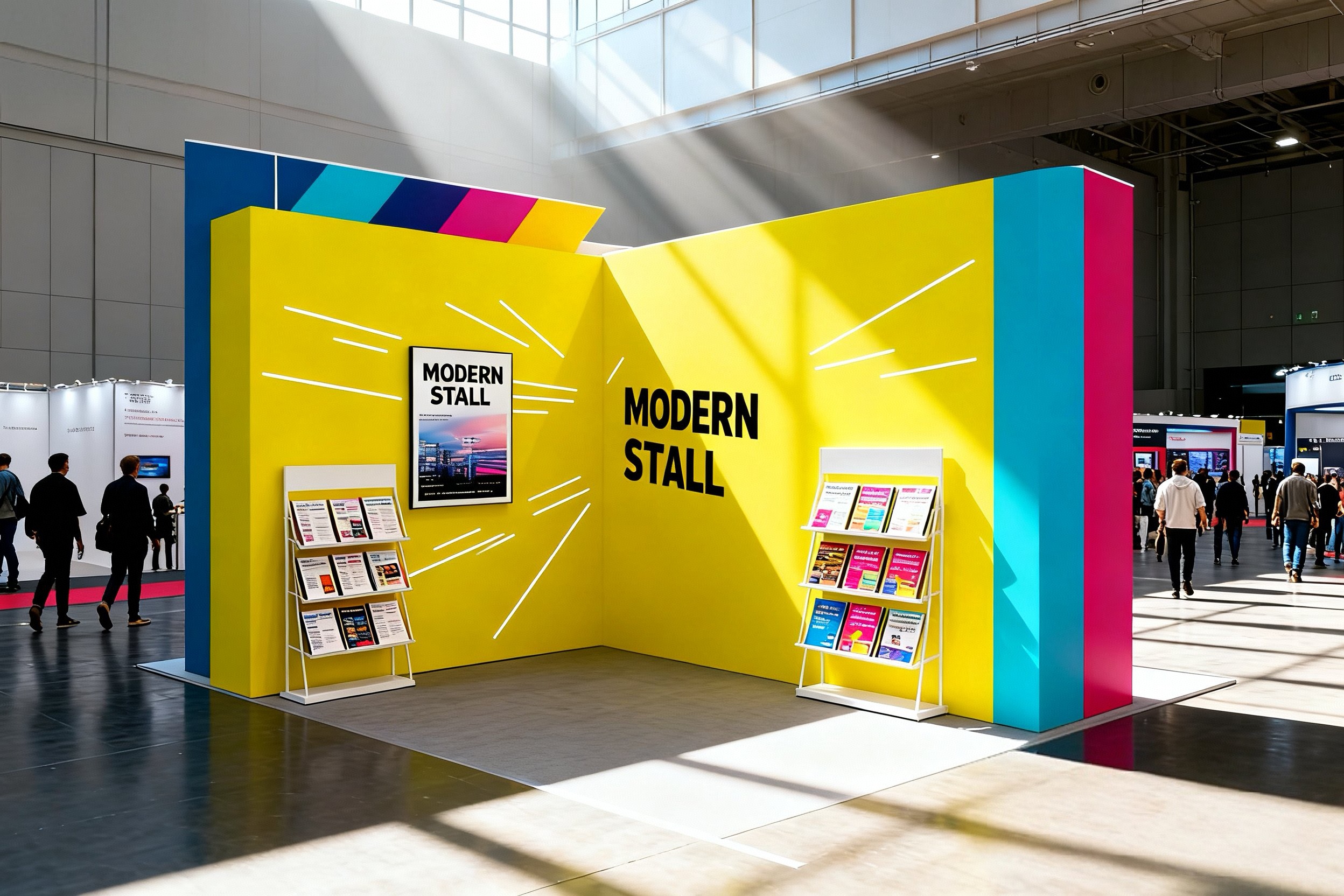
An inline booth layout has one main approach edge. This can make the visitor journey straightforward: arrive from the aisle, identify the relevant activity, step inside and speak with the team.
It suits an exhibit with a clear sequence, such as viewing a sample before watching a demonstration. The challenge is ensuring that visitors already participating do not occupy the only useful entrance.
Place the main activity far enough inside the footprint for people to engage without standing in the aisle. Test the entrance with an existing visitor group present. If someone new cannot see how to join, change the activity position or reduce the furniture.
How a corner changes the layout
A corner provides two approach directions. Someone may see the side of the exhibit before seeing its main graphic. Review the design from both aisles, including the backs of screens and the side faces of counters.
Decide whether both sides should function as entrances or whether one should primarily communicate the offer. That choice depends on the activity and available interior space. Two nominal openings are not helpful if both lead into the same congested station.
For a demonstration, position the presenter and screen so viewers gather inside the booth. Watch what happens at the outside corner: it can become a convenient meeting point that blocks access from both aisles.
Do not automatically add a tall side wall
An L-shaped graphic arrangement can be useful when its panels are correctly located, but a tall wall along the newly open aisle may sacrifice visibility. Assess the plan view and the view of a person approaching from that aisle.
Likewise, do not assume that a corner allocation permits unrestricted side-wall height. Obtain the event's requirements for the assigned booth type before finalizing any wall or header. [1]
A portable exhibition display stand should be chosen for its assembled footprint and viewing surfaces as well as its graphic area. Exposed backs, projecting feet and service cables become especially visible when people approach from two sides.
Compare the staffing task
In an inline position, the team can monitor one main approach. At a corner, staff need an agreed way to notice arrivals from either side. They also need to avoid greeting the same visitor simultaneously.
Assign a simple handoff during busy periods. One person may manage an active demonstration while another welcomes arrivals and directs follow-up. Test this with the actual number of staff available, rather than assuming a corner automatically needs a larger team.
Use the booth boundary as the limit for your working area. Neither position should depend on staff, queues or loose materials occupying the public aisle.
Is the corner premium worthwhile?
Ask for the actual difference in booking price, then list any additional graphics or finishing needed for the extra exposed side. Consider whether the event's traffic pattern creates relevant approaches from that direction.
You can also make an internal scenario calculation. If the additional booking and display cost were $500, and your own agreed planning value were $100 per qualified conversation, the extra cost would correspond to five additional conversations. Those figures are hypothetical assumptions, not a forecast of what a corner position will deliver.
Use past event records where available. Compare qualified interactions and follow-up outcomes, rather than assuming more passing traffic means a better result.
Frequently asked questions
Is a corner booth always better? No. Its extra exposure is useful when the design, traffic pattern and staffing can take advantage of it.
Can an inline display be reused in a corner? Possibly. Review exposed surfaces, stability, graphic placement and visitor approaches before reusing the configuration.
Can I enclose one of the corner's open sides? Check the organizer's rules and assess the effect on access and visibility. The rented footprint alone does not determine what construction is permitted.
Share your assigned position and neighboring aisles with QuicklyShow to discuss a custom trade show booth layout for a corner or inline space.
[1] IAEE Guidelines for Display Rules and Regulations, 2019 North American Update. Consult the event organizer for the rules that apply to your assigned space.
