
No products in the cart.
What Makes a Trade Show Booth Compliant with Green Exhibition Principles?
At the end of an exhibition, two booths can look equally impressive but leave very different results behind. One is cut apart and discarded. The other is dismantled, counted, packed and prepared for its next layout.
A green exhibition booth should demonstrate reusable construction, controlled material use, low-pollution installation, efficient lighting and a practical recovery plan. Product features may align with these principles, but formal compliance or certification depends on the exact assessment program, project evidence and any required third-party review.
ALT: Reusable modular green exhibition booth with aluminum structure and replaceable fabric graphics
The difference between alignment and certification
An aluminum frame, tool-free connections or LED lighting can support a green evaluation. None of these features alone certifies the whole booth. A credible assessment asks what materials entered the venue, what was reused, what became waste, how installation was managed and which documents support the answers.
Likewise, a green booth is not automatically carbon-neutral. Carbon-neutral claims require a defined emissions boundary, calculation, reductions, treatment of residual emissions and appropriate verification.
Seven principles used in practical booth evaluation
Think of the following principles as a chain. A reusable frame is valuable, but its benefit weakens if parts are lost during dismantling, replacement graphics are undocumented or the packing cannot survive the return journey.
1. Retain the main structure
Long-life frames should be dismantled, packed and used again. QuicklyShow’s aluminum booth structures can typically serve for approximately three to five years with proper care.
2. Maximize reusable modules
Walls, lightboxes, counters and accessories should be planned as an inventory. Moving from 10×10 ft to 10×20 ft normally requires a revised design and additional modules, while a smaller layout can use selected parts from a larger inventory.
3. Separate graphics from hardware
Replaceable fabric graphics allow exhibitors to change communication without replacing the aluminum structure. A frameless slim LED fabric lightbox is one example of a long-life frame combined with a changeable SEG surface.
4. Reduce venue fabrication
Factory-finished, tool-free systems reduce the need for on-site cutting, drilling and painting. They also make dismantling more predictable because parts remain identifiable.
5. Control solid waste
Some green-booth scorecards use a solid-waste generation target of 15% or less. This must be measured for the project: discarded booth-related material weight divided by total booth material input. Until weighing is completed, describe the booth as designed to minimize waste rather than guaranteeing a percentage.
6. Use lighting efficiently
Selected QuicklyShow lightboxes use integrated high-brightness LED modules and can be configured for 110V or 220V markets. Energy performance should be supported with power specifications when available.
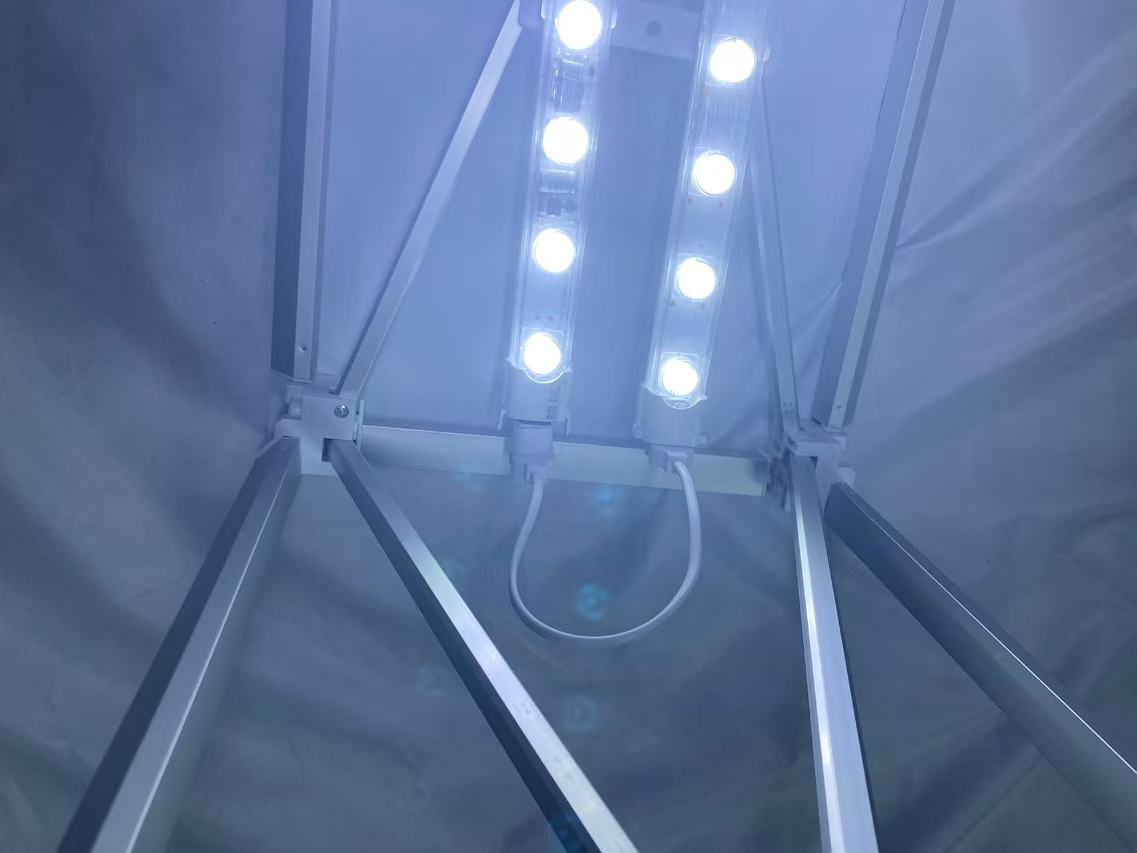
ALT: High-brightness LED modules and connection cable illuminated during a lightbox factory test
7. Recover packing and components
Reusable bags, foam inserts and labeled component positions help the crew retrieve every frame, cable and fitting after the event. Outer cartons can also be retained when their condition and transport requirements allow it.
Evidence a buyer should keep
- bill of materials and component photographs;
- drawings showing retained, added and removed modules;
- packed dimensions, gross weights and package counts;
- installation and dismantling instructions;
- electrical specifications and destination-market documents;
- fabric, ink, adhesive or flame-resistance records where applicable;
- waste-weighing records; and
- photographs showing reuse at later exhibitions.
An example assessment statement
A careful website statement might read:
This booth is designed around key green exhibition principles, including reusable aluminum structures, replaceable fabric graphics, tool-free assembly, LED illumination and recoverable transport packing. Project-specific environmental performance depends on configuration, graphics, freight and end-of-event handling.
This is more defensible than claiming universal certification or zero environmental impact.
What this looks like on show day
The crew opens labeled bags, connects factory-finished modules, installs the fabric graphics and tests the LEDs. After the event, the same parts return to their assigned positions. That visible process—supported by an inventory and photographs—is more useful to an evaluator than a broad “eco-friendly” label on its own.
Frequently asked questions
Does GB/T 41129-2021 certify an individual product automatically?
No. It is a green booth evaluation guide. An individual project must be assessed using applicable criteria and evidence; owning a modular product is not itself a certification.
Is a reusable booth always a green booth?
Not necessarily. Reuse is important, but materials, energy, waste, logistics and installation practices also matter.
Can the printed graphic be excluded from waste calculations?
It should not be silently excluded. State the assessment boundary and record replaced or discarded graphics accurately.
Prepare evidence before the event
Start with What Is a Green Trade Show Booth? and use QuicklyShow’s contact page to submit the floor plan, event city and documentation requirements for review.
