
No products in the cart.
Best Portable Trade Show Display for Small Business: A 2026 Buying Guide
The best portable trade show display for a small business is the one your team can transport, assemble and use consistently. A display that looks impressive in a supplier's photograph may be a poor fit for one employee traveling with samples and limited storage.
This 2026 buying guide uses a selection framework rather than an untested product ranking. Begin with your event calendar, visitor activity and transport constraints, then compare complete configurations against the same brief.
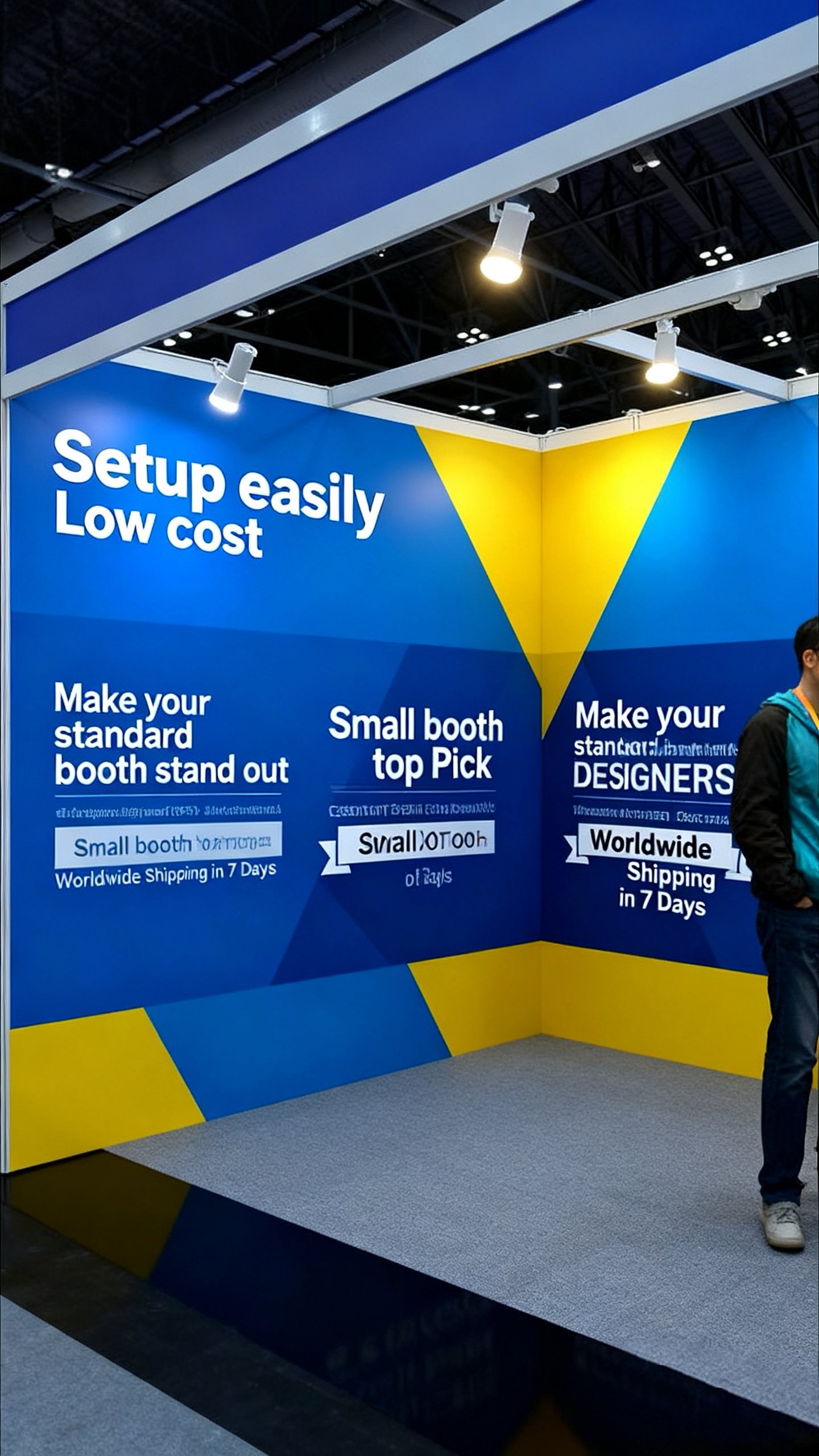
Write a short operating brief
Record the booked footprint, open sides, number of staff and primary interaction. Add the largest product or sample you must bring. State whether visitors need a demonstration surface, product shelves or seating.
Next, describe the journey. Will the kit travel in a car, through a parcel network or with a freight carrier? Is there an elevator at the storage location? Who moves the cases between the vehicle and the booth? These details are part of portability, even when they do not appear in a product name.
Shortlist by configuration
A compact backdrop and counter can support a focused introduction or consultation. A display with dedicated sample surfaces may be better when visitors need to handle products. A modular kit is worth considering when future events require a different arrangement.
Do not assume that a more configurable system is automatically the stronger choice. Extra connectors, graphics and accessories add purchasing and inventory decisions. A portable booth for a startup should solve the current operating problem while leaving a realistic path for change.
Use a weighted scorecard
Choose your weights before seeing the prices. The example below is a planning tool; change it to match your business. Score each proposed kit from one to five, then multiply by the weight. A high score means it fits the stated need, not that it is universally superior.
| Criterion | Example weight | Evidence to request |
|---|---|---|
| Transport fit | 30% | Packed dimensions, gross weight and case count |
| Assembly fit | 25% | Instructions and a complete setup demonstration |
| Visitor activity | 20% | Measured layout with equipment and people |
| Graphic replacement | 15% | Replacement specification and quotation |
| Storage fit | 10% | Stored footprint and packing method |
Use a minimum requirement as well as a score. If a loaded case cannot be handled by the available team, a strong average score should not conceal that failure.
Ask for a complete quotation
Compare hardware, graphics, lights, cases, delivery and any required accessories. Ask whether the price includes a ready-to-use configuration or only the main frame. Record taxes and event services separately where applicable.
For a lightweight portable trade show display, request gross packed weight rather than frame weight. For a portable booth kit, request an itemized inventory. This makes it easier to check the delivery and to identify a missing part before the event.
Test the kit before treating it as event-ready
Run a rehearsal with the people who will use it. Start with closed cases and finish with the display ready for visitors. Include graphics, lighting, samples, lead capture and packing-material storage.
Record where the team pauses to interpret instructions or identify components. A supplier demonstration can show the intended method; your rehearsal shows whether your team can repeat it. Keep labeled photographs and a packing map with the kit.
Compare ownership across several events
Build a simple event-by-event budget. Include graphic changes, transport, replacement parts and storage as well as the initial purchase. If you compare rental, use quotations with similar inclusions and responsibilities.
Avoid dividing purchase cost by an optimistic number of future shows. Start with the events you actually plan to attend, then model additional uses as a separate scenario.
Frequently asked questions
Should a first-time exhibitor buy the cheapest display? Only if it meets the operating brief. A missing case or incompatible accessory can change the apparent saving.
Is a modular kit necessary for a small business? No. It is useful when the planned changes justify its components and complexity.
What should I send a supplier first? Your footprint, visitor activity, artwork, transport limits and event date.
Share that brief with QuicklyShow to compare suitable configurations for your small business trade show display.
