
No products in the cart.
How to Calculate the Reusable Material Rate of a Trade Show Booth
The hall is almost empty after dismantling. Aluminum frames are back in their bags, graphics are folded, cables are counted and a small pile remains for disposal. This is the moment when a reusable-material claim can become a measured result instead of a marketing phrase.
The basic calculation is straightforward:
Reusable material rate (%) = weight of materials retained for reuse / total booth material weight within the assessment boundary × 100
The difficult part is defining the boundary, weighing consistently and proving that the retained components will actually remain in service.
Define the assessment boundary first
Before weighing anything, state whether the calculation includes the booth structure, counters, lights, cables, graphics, flooring, furniture and transport packing. Do not quietly exclude fabric graphics simply because they may change at the next event.
A useful project boundary might include every booth-specific item delivered to the stand, while separately reporting rented venue furniture or products displayed by the exhibitor. If a particular green-exhibition program supplies its own formula, follow that program rather than substituting a different one.
Where the reusable value comes from
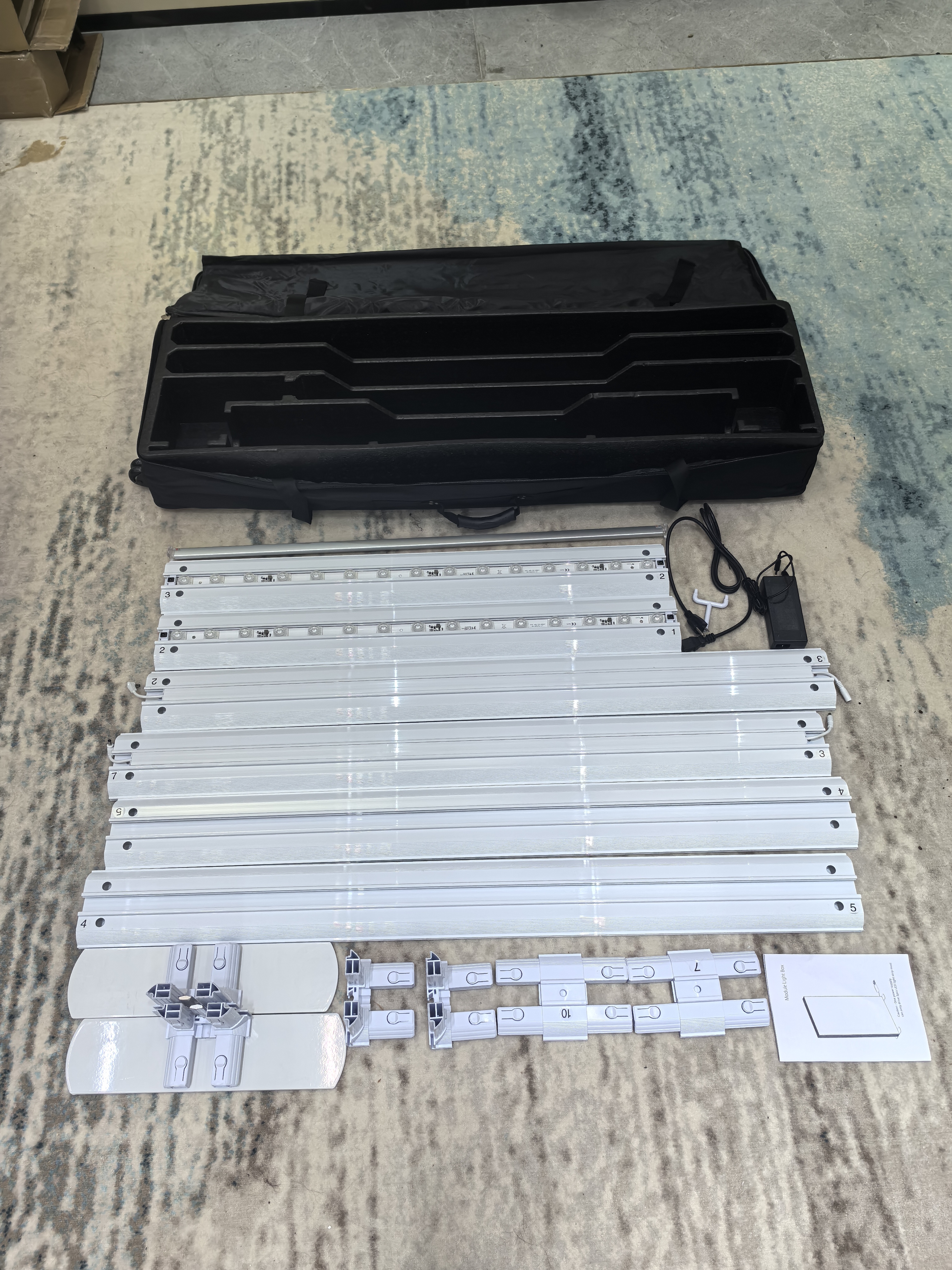
A portable booth is environmentally preferable when its main components remain useful after the event instead of becoming a one-show construction. The table below explains how the principal parts of a QuicklyShow-style system support repeated use.
| Booth component | Material or construction | Environmental advantage |
|---|---|---|
| Main frames | Lightweight aluminum | Can be dismantled, stored and assembled repeatedly for approximately three to five years with proper care |
| Connectors and feet | Replaceable hardware | Individual worn or damaged pieces can be replaced without discarding the complete structure |
| Fabric graphics | Dye-sublimated textile | Graphics can be removed and changed for a new campaign while the frame remains in service |
| LEDs, drivers and cables | Serviceable electrical components | Energy-efficient lighting can be tested, stored and reused with the lightbox structure |
| Counter modules | Aluminum frame with replaceable fabric | Can be reused with new artwork and combined with different booth layouts |
| Carry bags and cases | Durable Oxford fabric or wheeled cases | Protect the booth during transport and can be used again after every exhibition |
This component-based construction is the main reason the booth can retain a high proportion of its material value. Exact reuse percentages still depend on the final configuration and what is actually recovered after each event.
What counts as retained for reuse?
A frame does not count merely because it could theoretically be reused. It should be dismantled without destructive cutting, recovered from the venue, checked and placed into storage or the return shipment.
QuicklyShow’s aluminum structures are designed for repeated assembly and can typically remain in service for approximately three to five years with proper care. Replaceable fabric graphics, modular counters, LEDs and reusable packing can also remain in the inventory when their condition and future requirements allow.
A worked example
Assume the defined booth boundary weighs 120 kg. After the event, 105 kg of frames, hardware, lights, graphics and packing are recovered for another use. Fifteen kilograms are discarded.
Reusable material rate = 105 / 120 × 100 = 87.5%
This example is illustrative, not a measured QuicklyShow project result. A buyer should keep scale records, photographs and the signed dismantling checklist for the actual booth.
Layout changes do not cancel reuse
A 10×10 ft booth reused in a 10×20 ft space will normally require a revised design and additional modules. The original material can still count as reused if it remains in the larger layout. In the opposite direction, selected components from a 10×20 inventory can serve a 10×10 footprint while the unused modules remain in storage.
Avoid three common calculation errors
- Counting intended reuse as completed reuse. Record what was actually recovered.
- Changing the boundary after dismantling. Use the same included materials in the numerator and denominator.
- Confusing reuse with recycling. A frame used again is reused; an end-of-life frame sent to a material processor is recycled. Report them separately.
Frequently asked questions
Should transport bags count?
Yes, when they are inside the project boundary. Durable zippered Oxford-fabric bags and wheeled cases can be recorded as retained packing when they return with the components.
Can replaceable graphics count as reusable materials?
Yes when the same graphic is recovered for a later event. A graphic replaced after the show should be recorded according to its real destination.
Does a high reusable-material rate prove carbon neutrality?
No. It measures material retention within a stated boundary, not the booth’s complete greenhouse-gas balance.
Turn the inventory into a reuse plan
Read What Makes a Booth Compliant with Green Exhibition Principles and contact QuicklyShow with the floor plan and evidence requirements for a component-based proposal.
