No products in the cart.
Modular vs. Traditional Trade Show Booths: Which Is More Sustainable?
A modular trade show booth is usually the stronger sustainability option for frequent exhibitors when the same components are genuinely reused across layouts. A traditional custom build may still be appropriate for a one-time flagship experience, but its environmental performance depends heavily on material recovery after dismantling.
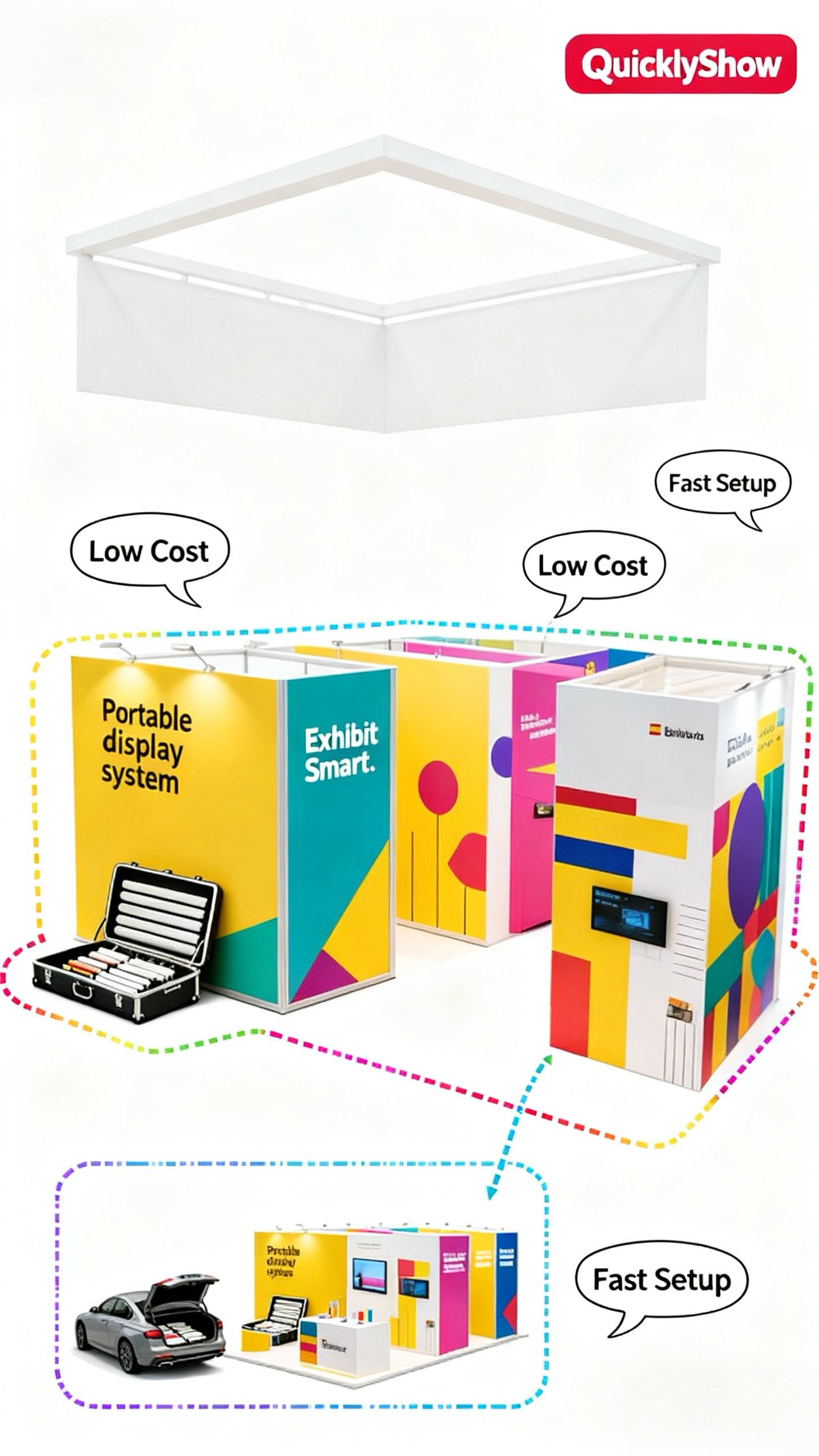
ALT: Modular trade show booth system reconfigured with reusable display components
Consider two exhibitors. Company A attends one major launch and needs a unique immersive structure. Company B attends eight shows a year, moving between 10×10 and 10×20 ft spaces. A responsibly recovered traditional build may suit Company A, while Company B is more likely to benefit from a modular inventory that changes with each floor plan. Sustainability depends on the use pattern, not just the booth label.
Quick comparison
| Factor | Modular portable booth | Traditional custom build |
|---|---|---|
| Structure | Standard reusable components | Often project-specific construction |
| Layout changes | Components can be recombined | May require rebuilding |
| Graphics | Usually replaceable independently | May be bonded to panels or surfaces |
| Venue work | Often tool-free or low-tool | May involve cutting and finishing |
| Packing | Compact bags and cartons | Often larger crates or local disposal |
| Visual freedom | High within a system | Very high for unique forms |
| Best use case | Repeated events and changing footprints | One-off experiential projects |
Why modular systems can perform better
The environmental benefit comes from repeated use. QuicklyShow's main aluminum structures can typically be used for around three to five years with proper care. Standard components can be separated and recombined, while fabric graphics are replaced independently when branding changes.
Tool-free connections reduce the need for on-site cutting or painting. Lightweight components and packages generally kept within 1.3 meters can also simplify storage and transport. Selected lightbox modules use high-brightness energy-efficient LEDs and support destination-specific 110V or 220V configurations.
Where a traditional booth can still make sense
A custom build can provide unusual architecture, specialized materials or a highly immersive environment. It may also use locally rented and recovered materials effectively. Therefore, "traditional" does not automatically mean unsustainable.
The important questions are whether the structure has a reuse plan, whether materials can be separated, how much venue fabrication is required and what is discarded. A locally reused conventional system may outperform a modular booth shipped long distances for a single event.
Compare lifecycle cost, not purchase price
Include hardware, graphics, freight, storage, labor, repairs and disposal over the expected number of events. A modular system can cost more than a basic one-time solution at the first show but become more economical as the frame is reused. A highly custom build may justify its cost when a single launch experience is the primary objective.
Avoid three misleading assumptions
"Aluminum means sustainable"
Aluminum is durable and recoverable, but the frame must actually remain in service. Document reuse and repair.
"Modular means zero waste"
Graphics, packaging, damaged parts and consumables may still become waste. A below-15% solid-waste target requires measurement.
"Small packaging means carbon-neutral"
Compact packing can reduce transport requirements, but carbon neutrality requires a complete, defined calculation and appropriate verification.
Choose modular when
- you attend several shows each year;
- your floor space changes between events;
- branding changes more often than the structure;
- your team needs predictable installation;
- compact storage and replacement parts matter; or
- you want to reduce venue fabrication and dismantling waste.
Choose a traditional custom approach when an exceptional one-time environment is essential and a credible local material recovery plan is available.
For Company B, the practical workflow might be simple: use a backwall and counter at a 10×10 event, add walls or illuminated modules for 10×20, and store the unused pieces when the footprint becomes smaller again. The same graphics can continue while the campaign is current; new graphics are ordered only when the message changes.
A buyer can compare the structure of a 10×10 modular portable booth with a 20×10 ft modular LED booth. The exact expansion still requires a revised design and any additional modules identified for the larger floor plan.
Frequently asked questions
Can a modular booth look custom?
Yes. Custom fabric graphics, illuminated modules, counters, shelving and varied layouts can create a distinctive result while retaining standard hardware.
Which booth is better for frequent exhibitors?
A modular system is generally more practical because costs and structural materials are spread across more events.
How should buyers verify sustainability?
Request material lists, packed data, multiple-layout drawings, installation instructions and measured recovery or waste records.
Select by evidence and event frequency
Start with What Is a Green Trade Show Booth? and Are Portable Booths Eco-Friendly?. Send QuicklyShow your annual event schedule for a modular configuration comparison.
